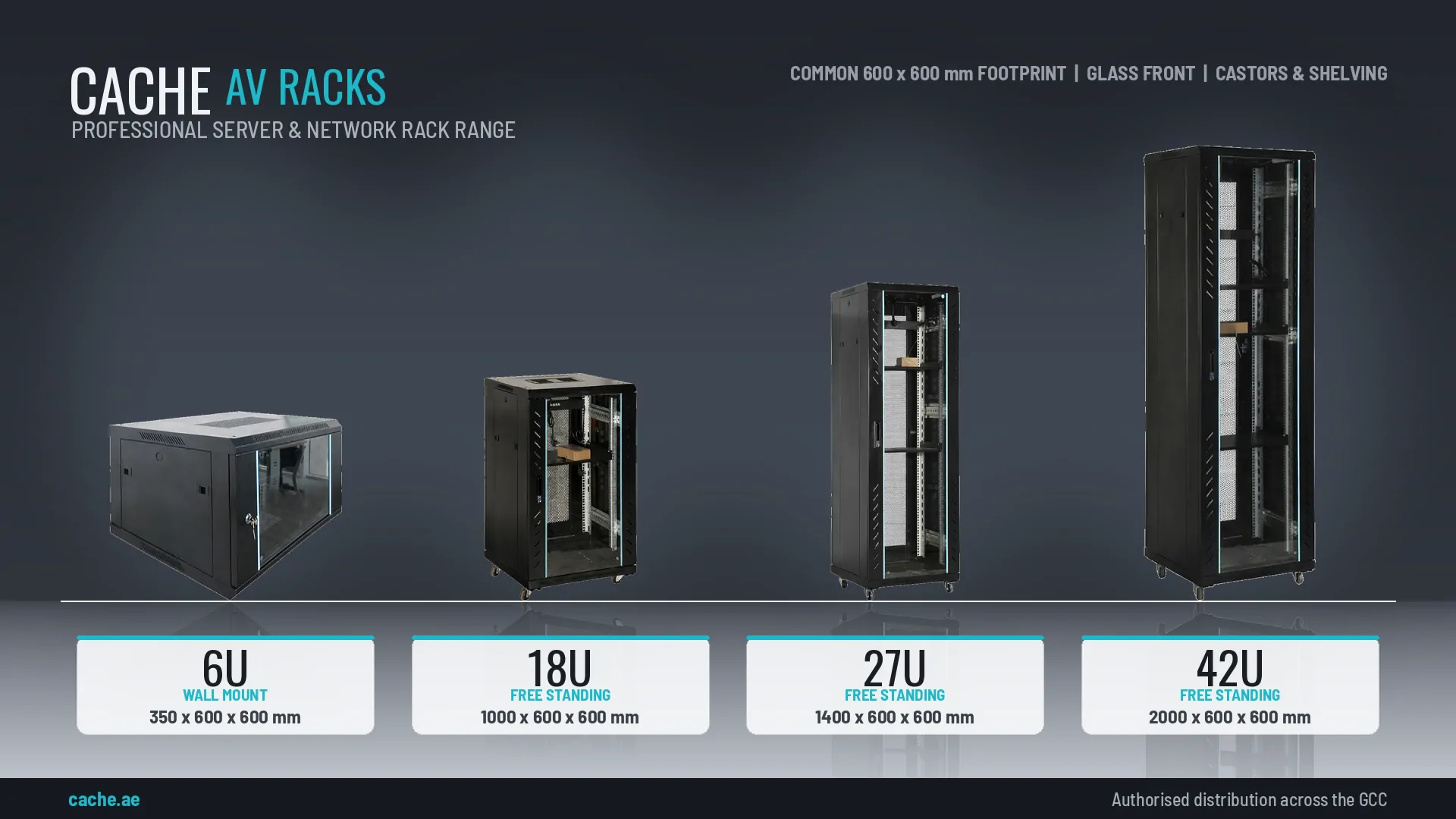
Choosing an AV rack starts with what goes inside it, not the rack itself. Work out the equipment, the space it needs in rack units, how much heat it produces and where it will sit, and the right rack almost picks itself. This guide walks integrators through sizing, rack types, cooling, power and sourcing, so the rack you specify fits the project the first time.
Get the rack wrong and everything downstream suffers: kit that does not fit, gear that overheats, cabling that cannot be serviced, and a fit out that slips because the right rack is weeks away. Get it right and the rack quietly does its job for the life of the install.
Before you look at any rack, list the equipment it has to hold. Switches, matrices, amplifiers, media players, network gear, power management and any integration gateways all take space and produce heat. Note the depth of the deepest item and the weight of the heaviest, because both decide which racks are suitable. It also helps to leave room for what comes later. Most projects grow, so a rack that is full on day one will be a problem within a year. Plan for spare capacity from the start.
Rack space is measured in rack units, written as U. One U is 1.75 inches, or 44.45 mm, of vertical mounting height, and almost all professional AV and IT equipment is built to this standard 19 inch width. So a device described as 2U takes two units of height in the rack. Add up the U height of every item, then add spare units for airflow and future kit. Depth matters just as much: measure your deepest unit, including cables and connectors at the back, and make sure the rack is deep enough to close cleanly. A rack that is tall enough but too shallow is a common and avoidable mistake. If rack units and U heights are new to you, our guide to what a server rack is and how to size one covers the fundamentals.
There are three broad types, and the right one depends on location and access. Open frame racks are two or four post frames with no panels, ideal for ventilated equipment rooms where access and airflow matter more than dust protection. Wall mounted racks are compact enclosures or brackets for small installs and tight spaces, common in apartments or where there is no dedicated room. Enclosed floor standing racks are fully panelled cabinets, the default for larger systems, equipment rooms and anywhere the rack needs to look finished or stay locked. Many villa projects pair a floor standing rack in a plant room with a small wall mounted rack closer to the displays.
Heat is the single biggest risk to AV equipment in this region, and racks make it worse by packing hot kit into a small volume. In the UAE you have to plan cooling deliberately rather than hope an air conditioned room is enough. Allow space around heat producing equipment, fit ventilation or fans where airflow is restricted, and avoid sealing a hot rack into a cupboard with no air movement. For enclosed racks, plan how air enters at the bottom and leaves at the top. A rack that runs cool protects the equipment inside it and saves you call backs for kit that fails in the summer.
A rack is only as good as the power and cabling behind it. Specify rack mounted power distribution with enough outlets and the right protection, and leave a spare circuit where you can. Plan cable management and structured cabling early, with horizontal and vertical routes, labelling and enough slack to pull a unit forward for service. Finally, check the load rating. A fully loaded rack of amplifiers and power gear is heavy, so confirm both the rack and the floor or wall can take the weight. These details are easy to skip on paper and expensive to fix once the rack is installed.
For villas, the choice usually comes down to the plant room. Where there is a dedicated space, a floor standing enclosed rack keeps everything tidy, serviceable and cool. Where there is not, wall mounted racks let you place smaller amounts of equipment closer to where it is used. For commercial and hospitality projects, floor standing racks are the norm, chosen for capacity, security and central servicing across many rooms or zones. In both cases, decide the rack location during design, not on site, because it affects cabling, cooling and access for years.
The best specified rack is no use if it arrives after your install date. This is where local supply matters. Cache holds AV racks and accessories in UAE stock with next day delivery, so integrators can order to a project timeline rather than waiting on overseas shipping. If you are planning a build, you can browse our AV and server rack range in Dubai and talk to our team about sizing, cooling and accessories for the system you are designing. For sizing help on network and comms racks, see our network rack guide for Dubai.
One detail worth knowing: every rack worth specifying conforms to the EIA-310 standard, the 19 inch specification that keeps rack mount AV, networking and control equipment compatible across brands. Check it when you are mixing kit from different manufacturers.
Whatever the project, the right rack starts with the kit going into it. Plan size, cooling and power early, then order from local stock. Browse our AV rack range or contact us for a project quote.
Add up the rack unit height of every piece of equipment, then add spare units for airflow and future kit. Check the depth of your deepest item as well, since a rack that is tall enough but too shallow will not close.
A U is one rack unit, equal to 1.75 inches or 44.45 mm of vertical mounting height in a standard 19 inch rack. A 2U device takes two units of space.
Yes. Heat is the main cause of equipment failure here, so plan ventilation or fans, leave space around hot kit, and never seal a loaded rack into a cupboard with no airflow.
An open frame rack is a panel free frame that maximises access and airflow in a dedicated room. An enclosed rack is a panelled cabinet that protects equipment, can be locked, and looks finished in exposed locations.
Cache supplies AV racks and accessories to integrators across the UAE, with local stock and next day delivery. Contact our team for sizing advice or a project quote.
We use cookies to ensure you get the best experience on our website.
