A fan coil unit, or FCU, is the part of an air conditioning system that sits in or near the room it serves, drawing air across a coil and blowing it back into the space at the temperature you have asked for. It has three working parts: a coil carrying chilled water or refrigerant, a fan that moves air across it, and a control that decides when and how hard to run. Almost every apartment, hotel room and office floor in Dubai is cooled by one.
This guide explains what a fan coil unit is, how it works, the types you will find in UAE buildings, how an FCU differs from a split or VRF system, and how to control and integrate fan coil units so a building stays comfortable without wasting energy.
A fan coil unit is a simple device doing a straightforward job. Cold water, or refrigerant, is piped to a heat exchange coil. A fan draws room air across that coil, heat moves from the air into the water, and the cooled air is delivered back into the space through a grille or a short run of duct. A filter sits in front of the coil to keep dust off it, and a drain pan underneath collects the condensate that forms as warm humid air meets a cold surface. There is no compressor in the unit itself. The cooling is produced somewhere else, in a chiller or a district cooling plant, and the FCU is the terminal device that delivers it room by room.
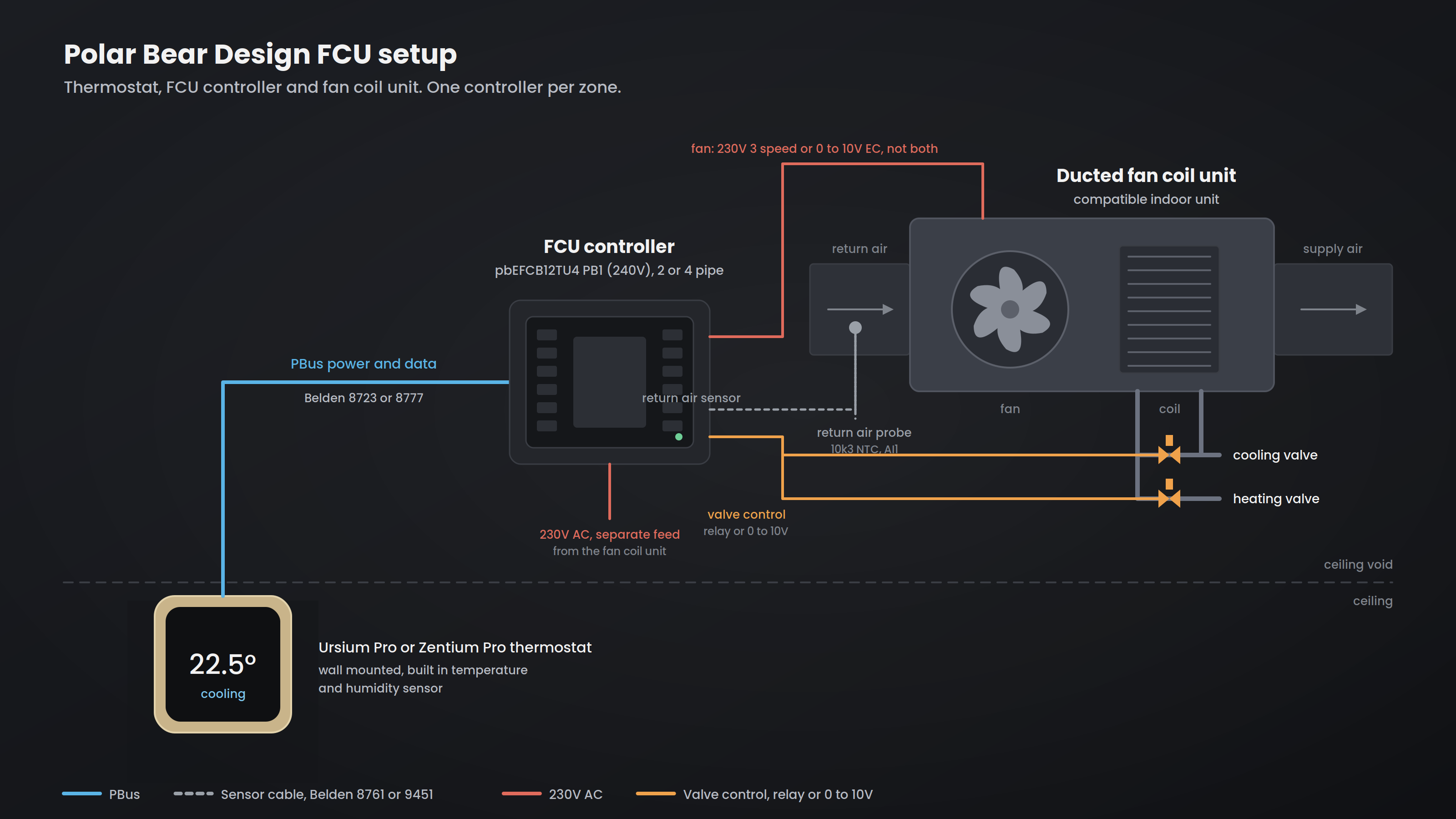
In a chilled water building, the sequence starts at the thermostat. When the room temperature rises above the set point, the control opens a valve on the coil and lets chilled water flow, and it runs the fan at low, medium or high speed. Air passes over the coil, gives up its heat, and returns to the room cooler and drier. When the room reaches the set point, the valve closes and the fan either stops or drops back. The whole loop is local: one unit, one zone, one thermostat, which is why fan coil systems give such good room by room control in buildings with many separate spaces.
Ceiling concealed units are the most common in apartments and villas, hidden above a false ceiling with supply and return grilles in the ceiling below. Cassette units mount flush into the ceiling and blow air out of two or four sides, and are favoured in offices and retail. Exposed ceiling or wall mounted units are used where there is no ceiling void, common in back of house areas. Floor mounted units sit under windows or in risers, often in older buildings and hotels.
The pipework matters as much as the box. A two pipe fan coil has one flow and one return, so the whole system is either cooling or heating at any one time, which suits the UAE where cooling runs almost all year. A four pipe fan coil has separate cooling and heating circuits and can do either on demand, which you see in hotels and mixed use buildings that need both at once.
Dubai is built on central cooling. Towers, hotels, malls and most master planned communities take chilled water from a district cooling plant or a central chiller and distribute it around the building in pipes. That model needs a terminal device in every room, and the fan coil unit is it. The advantages for a developer are plain: no outdoor condenser per apartment, no refrigerant pipework running through the building, quieter facades, and a single plant to maintain. For occupiers it means each room has its own thermostat and its own fan speed, which is exactly what a hotel or an office floor needs. The trade off is that an FCU is only as good as its control and its maintenance, and both are often the weak point.
A split system has its own outdoor condenser and makes its own cooling for the space it serves. A VRF system uses one outdoor unit to feed many indoor units with refrigerant, varying the flow to match demand, and is common in villas and smaller commercial buildings. A chilled water fan coil system makes no cooling locally at all: it receives water from a central plant and moves heat into it. In practice you will find all three in the UAE, often in the same development. If you want the detail on the refrigerant side, our guide to what a VRF system is covers it.
It is worth knowing that the indoor units in a ducted split or VRF system are themselves fan coils in everything but name, a coil and a fan in a box. The difference is what is in the pipe: refrigerant rather than chilled water.
Control is where most of the money is won or lost. A basic FCU thermostat does two things: it opens and closes the water valve and it switches the fan between speeds. A good one adds scheduling, sensible set point limits, occupancy setback and a readable interface, and it does not look like an afterthought on the wall of a finished interior. In luxury residential and hotel work, Polar Bear Design thermostats from the Ursium and Zentium ranges are built for this: British made HVAC control designed to sit alongside premium lighting keypads, so a room gets one consistent look instead of a mismatched panel beside every door. Our guide to what a smart thermostat is explains what to look for.
A thermostat on its own controls a room. Integration controls a building. Once fan coil units are connected to a building management system or an automation platform, you can see every zone at once, schedule floors and wings, set back empty rooms, and spot a failing unit from its behaviour rather than from a complaint. The catch is that HVAC equipment speaks its own languages, and a BMS cannot control what it cannot read.
On the refrigerant side, CoolAutomation solves this. Its CoolMaster gateways create a two way link between VRF, split and ducted air conditioning and the control system, using BACnet and Modbus for BMS work and KNX, Crestron and Control4 for automation platforms, so temperature, mode, fan speed, set points and fault status are visible and controllable for every indoor unit. For splits and multi-splits, typically the retrofit case, the product is CoolPlug: one CoolPlug is fitted to each indoor unit and every CoolPlug loops back to a CooLinkHub, which is the single point that talks to the BMS or automation system and covers up to ten indoor units. We have written in more detail on getting the most from HVAC systems with CoolMaster.
Fan coil units fail quietly. A blocked filter cuts airflow and the room never quite gets cold. A dirty coil does the same and wastes energy every hour it runs. A blocked condensate drain shows up as a stain on the ceiling, usually in August. A valve sticks open and a room is cooled around the clock whether anyone is in it or not. None of it is dramatic, which is the problem, because it goes unnoticed until someone complains. Clean filters on a schedule, keep coils and drains clear, and check that the controls are doing what the design intended. In a building with hundreds of units, remote visibility is the only practical way to know.
Cache supplies HVAC control and integration products to integrators, contractors and facilities teams across the UAE and GCC, with local stock and next day delivery. We are the exclusive UAE distributor for Polar Bear Design thermostats and for CoolAutomation HVAC integration. Whether you are fitting out a single villa or specifying controls for a whole tower, you can browse the thermostat range and the CoolAutomation range, or contact our team for advice and a project quote.
A fan coil unit, or FCU, is the terminal part of an air conditioning system that sits in or near the room it serves. It contains a coil and a fan: the coil carries chilled water or refrigerant, the fan moves room air across it, and the cooled air is returned to the space.
A thermostat compares room temperature with the set point. When cooling is needed it opens a valve so chilled water flows through the coil and runs the fan at low, medium or high speed. Air gives up its heat to the coil and returns cooler and drier. At set point the valve closes and the fan stops or drops back.
A split system makes its own cooling with its own outdoor condenser. A chilled water fan coil makes none: it receives water from a central chiller or a district cooling plant and moves heat into it. The indoor unit of a ducted split or VRF system is a fan coil in all but name, with refrigerant in the pipe instead of water.
A two pipe fan coil has one flow and one return, so the whole system runs in cooling or in heating at any one time, which suits the UAE. A four pipe fan coil has separate cooling and heating circuits and can deliver either on demand, which suits hotels and mixed use buildings.
Yes, through the controls. On the refrigerant side, CoolAutomation CoolMaster gateways give a BMS or automation platform two way control of VRF, split and ducted indoor units over BACnet, Modbus, KNX, Crestron and Control4. On chilled water systems, integration runs through the room thermostat and the building controls.
Cache distributes Polar Bear Design thermostats and CoolAutomation HVAC integration to integrators across the UAE and GCC, with local stock and next day delivery. Contact our team for advice or a project quote.
We use cookies to ensure you get the best experience on our website.
