Home cinema design is the process of shaping a room, its seating, its speaker layout and its acoustics around a single listening and viewing position, then choosing equipment that suits what the room can actually deliver. The order matters. A modest system in a well-proportioned, well-treated room will beat an expensive system in a bare cube every time. In UAE villas, where cinema rooms are often specified late and squeezed into whatever space is left, that order is the difference between a room that impresses and one that disappoints.
This guide covers how to design a home cinema in Dubai and the wider GCC, from room shape and seating through speaker layout, acoustics, picture and the rack that runs it all.
The room sets the ceiling on performance. Before anything is specified, three things need checking: proportions, isolation and services. Avoid rooms that are perfect cubes or where length, width and height are simple multiples of each other, because those dimensions stack room modes at the same frequencies and produce boomy, uneven bass. A ratio in the region of 1 to 1.4 to 1.9 for height, width and length is a safe starting point. Isolation matters just as much in a villa, where a cinema often sits next to bedrooms or a majlis, so plan for a heavier door, a proper seal and decoupled walls if the budget allows. Services are the quiet killer: a ceiling full of ducting and downlights leaves nowhere for height speakers, and an air conditioning grille firing straight at the seats will be audible in every quiet scene.
Work out the seating position first, then size the screen to it. The widely used guidance is a horizontal viewing angle of roughly 30 degrees for a comfortable reference position, rising towards 36 degrees for a more immersive, cinema style presentation. In practice, that puts the front row somewhere between 1.5 and 2 times the screen width away. Keep the main row off the rear wall by at least a metre, because sitting against it puts the listener in the worst place in the room for bass. If a second row is needed, plan the riser early, as it changes ceiling height, sightlines and the position of the surround speakers.
Channel count should follow the room, not the brochure. A 7.2.4 layout suits most villa cinema rooms and gives full Dolby Atmos height coverage without crowding the ceiling. Larger dedicated rooms with two rows justify 9.4.6, with wide channels and additional height speakers to keep the overhead image consistent across both rows. Keep the three front channels at ear height where possible, or use an acoustically transparent screen so the left, centre and right can sit directly behind it. Height speakers belong in the ceiling in defined pairs, not scattered around existing downlight positions. Bass wants at least two subwoofers, and preferably four, placed to even out room modes rather than tucked into whichever corner is free. Two well placed subs will always outperform one large one.
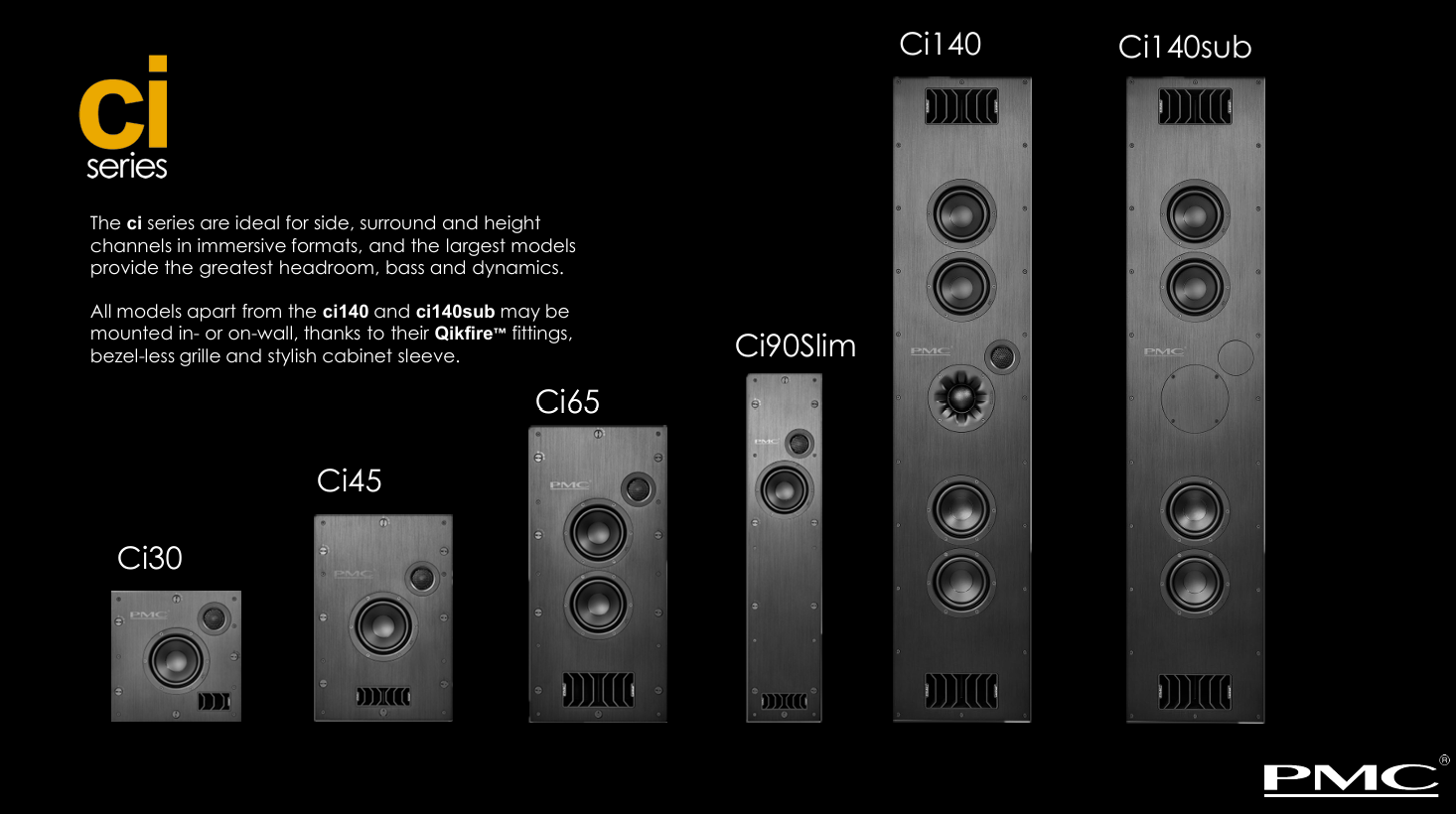
Architectural speakers have closed most of the gap on freestanding models, which is what makes them the default in villa projects where the interior design comes first. The PMC ci range brings the company's Advanced Transmission Line design into in wall and on wall formats, with the ci140 developed specifically as a flagship on wall LCR for cinema rooms and the smaller ci30 and ci45 models suited to surround and height duties. At the top of the market, Wisdom Audio, which Cache distributes in the UAE, uses planar magnetic line source drivers that hold their composure at very high output and control vertical dispersion, which is exactly what a room with a hard floor and a flat ceiling needs. Whatever the brand, keep the front three identical so that sound moving across the screen does not change character halfway.
Acoustic treatment is the cheapest performance upgrade in any cinema and the first thing to be value engineered out. A dedicated room should aim for a reverberation time in the region of 0.3 seconds, which is deader than a normal living space and is what gives dialogue its clarity. The essentials are absorption at the first reflection points on the side walls and ceiling, broadband absorption or bass trapping in the room corners where low frequency energy collects, and something soft on the rear wall to stop a slap echo bouncing back at the seats. Fabric wall systems handle the treatment and the finish in one, which is usually what wins the argument with the interior designer.
Choose the screen first, then the projector to suit its size, gain and the throw distance available. Paint the room properly matte black around the screen, since every reflective surface in the room lowers contrast, and contrast is what the eye reads as picture quality. The step most projects miss is video processing. A dedicated processor handles tone mapping of HDR content to what the projector can actually produce, which is the single biggest improvement available on a projection system. Cache is the exclusive madVR distributor for the GCC, and the Envy range covers everything from the compact Core through to the Extreme MK3, which adds motion processing and geometry correction on top of the tone mapping engine. On a large screen in a treated room, the difference is not subtle. Read what changed with the madVR Envy MK3 generation.
Everything above needs somewhere to live. Put the electronics in a ventilated rack outside the cinema itself, ideally in an adjacent store or plant room, so that fan noise and heat stay out of the listening space. Size the AV rack for the amplifier channel count with room to expand, and plan cooling properly, because a sealed cupboard in a UAE villa will cook a processor. Clean, dedicated power circuits for the audio and video equipment reduce noise and make fault finding far quicker. Air conditioning needs the same care: low velocity supply, no grille aimed at the seats, and integration into the wider control system so the room can be cooled ahead of time and set back when empty. Folding the cinema into the villa's smart home system, with HVAC integration handled by CoolAutomation, means one button brings lights, shading, cooling and the AV system to the right state together.
A recent Dubai project shows how the pieces come together: a 9.4.4 room in Tilal Al Ghaf built around Wisdom Audio in wall speakers behind an acoustically transparent screen, with the subwoofers designed into the wall cavities and the treatment planned alongside the interior finish rather than after it. You can read the full breakdown of that install in our Tilal Al Ghaf cinema case study. The common thread in rooms that work is sequencing: room, seating, layout, acoustics, then equipment.
Cache supplies home cinema products to integrators across the UAE and GCC, with stock held in Dubai and next-day delivery, plus technical support at the design stage rather than after the drawings are signed off. If you are specifying a villa cinema, we can help with speaker selection, layout, processing and rack design. Explore our approach to home cinema installation in Dubai or contact our team for product advice or a project quote. Integrators can also apply through the dealer programme.
What is home cinema design?
It is the process of designing a room and its systems around one viewing and listening position, covering room proportions, seating, screen size, speaker layout, acoustic treatment and equipment selection. The room is designed first and the equipment chosen to suit it.
How big should a home cinema room be in a villa?
There is no single answer, but avoid cube shaped rooms and dimensions that are simple multiples of each other. A ratio close to 1 to 1.4 to 1.9 for height, width and length is a good starting point, with enough length to keep the front row away from the screen and the rear row off the back wall.
How many speakers does a home cinema need?
A 7.2.4 Dolby Atmos layout suits most villa cinema rooms. Larger dedicated rooms with two rows of seating benefit from 9.4.6, with additional wide and height channels. Two or more subwoofers are strongly preferred over one, because multiple subs even out bass response across the seating.
Do I really need acoustic treatment?
Yes. Untreated rooms sound bright and unclear regardless of the equipment fitted. Absorption at first reflection points, bass trapping in the corners and treatment on the rear wall deliver a bigger improvement per dirham spent than upgrading the speakers.
Where can I buy home cinema equipment in the UAE?
Cache distributes home cinema brands including PMC, Wisdom Audio and madVR to integrators across the UAE and GCC, with local stock and next day delivery. Contact our team for design advice or a project quote.
We use cookies to ensure you get the best experience on our website.
