A video intercom is a door entry system with a camera built in, so instead of just hearing whoever is at the gate, you see them, from a phone app, an indoor touchscreen, or both, and can let them in without walking to the door. Cost depends on how many door and indoor stations a property needs and how it connects to the rest of the building, not on a single fixed price. This guide explains what a video intercom system is, what actually drives the cost, and how it works from the door station to the app or the wall.
A traditional audio intercom answers one question: who is at the door. A video intercom answers two: who is at the door, and what do they actually look like, right now, on camera. The door station outside carries a camera, a microphone and speaker, and a call button (or a keypad for PIN entry on some models). Press it, and the call routes to an indoor station on the wall, an app on a smartphone, or both at the same time.
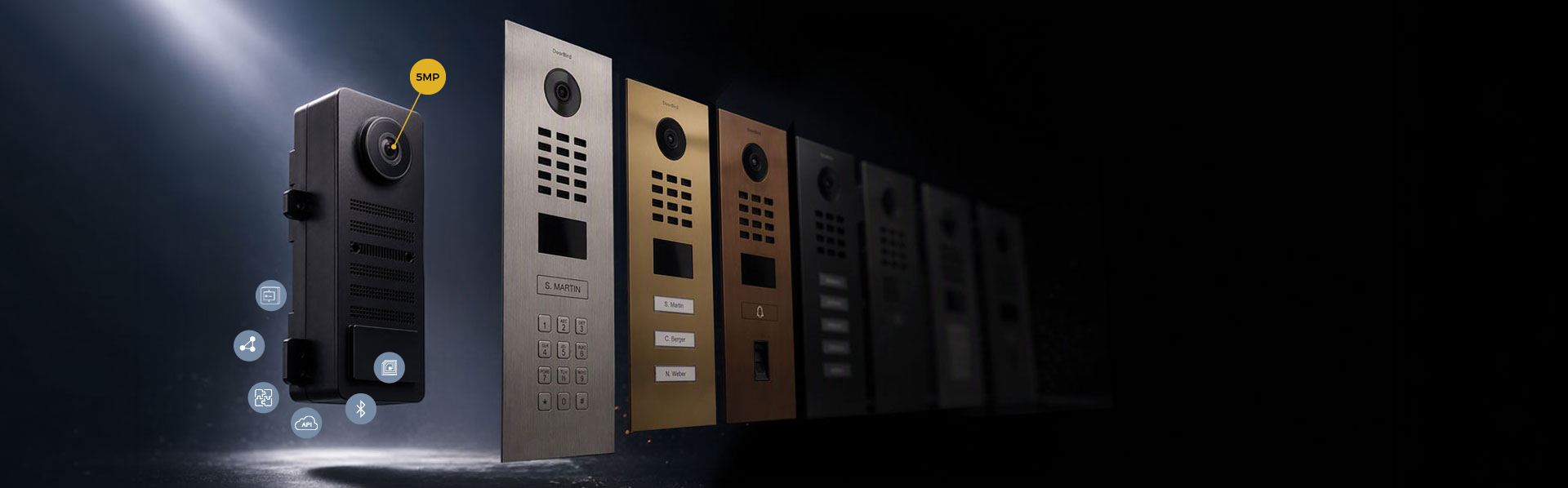
DoorBird, the brand Cache distributes across the UAE and GCC, builds its door stations this way: a wide-angle camera, infrared night vision and a motion sensor sit alongside the call button, and the unit is IP-based, so it talks to an app over WiFi or the internet rather than only ringing a wired bell inside the house.
At the door, the station is powered and connected to the network, most commonly over Power over Ethernet (PoE), which carries both power and data down one cable. When a visitor presses the call button, the door station pushes a live video and audio call to whatever is registered to answer it. That can be a dedicated indoor station mounted on a wall inside, the DoorBird app on a smartphone or tablet, or both together, and a single door station can call up to eight phones or tablets at once, so more than one household member can answer.
Whoever answers sees live HD video through the wide-angle camera, talks two-way with the visitor, and can release an electric door strike or gate opener from the same screen, all before anyone walks to the entrance. Recording of the visit is stored to the cloud as single images, at no extra monthly fee, so there is a record of who called even if nobody answered in time.
There is no single number that answers "how much does a video intercom cost", because the real drivers are the same ones that decide the cost of any door entry project:
How many entry points. A villa with one gate and one front door needs far less hardware than a compound with a vehicle gate, a pedestrian gate and a lobby door, each needing its own door station.
Door station only, or door plus indoor stations too. An app-only setup, common in apartments, needs just the outdoor unit. Adding a dedicated indoor station, such as the DoorBird A1103 touchscreen, for residents who want a fixed screen at the door rather than relying on a phone, adds to the bill of materials.
Keypad or card access. Models like the DoorBird D1101KV add a built-in keypad for PIN entry alongside the camera and call button, useful where staff or delivery access needs a code rather than a call every time.
Integration with the rest of the building. A standalone intercom is cheaper to install than one wired into an existing smart home platform, access control system or SIP phone network, because integration adds programming time even where the hardware cost is the same.
Because of this, Cache does not publish a single retail figure for "a video intercom" on cache.ae. DoorBird pricing is visible per model once you are logged in to a trade account, so an integrator can build an accurate quote for the actual property rather than working backwards from a generic number.
The terms get used loosely, but they are not quite the same product. A video doorbell is typically a single, often battery-powered unit aimed at one house on a consumer app, built for simple retrofit. A video intercom, or IP video door station, is built for both villas and multi-unit buildings, is normally powered over Ethernet for a permanent, wired installation, and is designed from the start to integrate with indoor stations, access control and smart home systems rather than work as a standalone app-only device.
Either approach works, and DoorBird supports both. The app answers the door station from anywhere over WiFi or mobile data, which is why an app-only setup is common in apartments where residents are used to managing everything from a phone. A dedicated indoor station adds a fixed answer point at home: the DoorBird A1103 is a 7 inch touchscreen with two-way HD audio, available in Black Edition and White Edition, connecting over WiFi or wired LAN with Power over Ethernet, so it works for both retrofit and new-build projects and pairs with any DoorBird door station.
Because DoorBird door stations and indoor stations run over IP, they are not limited to their own app. DoorBird is smart home compatible with platforms including Control4, Loxone, Crestron, RTI, ELAN and Fibaro, and connects to SIP-based phone systems, so a call at the gate can ring an integrator's control system alongside, or instead of, a phone. That makes the video intercom one entry point into a wider villa or building automation project, rather than a gadget that sits apart from everything else being installed.
Cache is an authorised DoorBird distributor supplying the UAE and GCC from Dubai. We are not the exclusive distributor for DoorBird, and we say so plainly, but we do carry the working range: the DoorBird D1101V video door station, the DoorBird D1101KV with its built-in keypad, and the DoorBird A1103 indoor touchscreen, each in flush-mount and surface-mount or Black and White Edition variants. Browse the full DoorBird range or contact our team for advice on the right combination for a villa entrance or a multi-apartment building.
A video intercom is a door entry system with a camera, so instead of just hearing a visitor you see them, on a phone app, an indoor touchscreen, or both. A door station sits outside with a camera, microphone and call button, and either an indoor station, a smartphone app, or both let you see, speak with and admit the visitor.
There is no single answer, because cost depends on how many door stations and indoor stations the property needs, whether it is a villa entrance or a multi-apartment building, and how it integrates with an existing smart home or access control system. DoorBird pricing on cache.ae is visible once you are logged in to a trade account, so an integrator can quote a project accurately rather than working from a generic list price.
Either works. The DoorBird app answers the door station from anywhere over WiFi or mobile data, up to eight phones or tablets can be called at once, so an app-only setup is common in apartments. A dedicated indoor station, such as the DoorBird A1103 touchscreen, adds a wall-mounted answer point for residents who prefer a fixed screen at the door, or a household that wants an in-home unit as well as the app.
Yes. DoorBird door stations and indoor stations work over IP, so they connect to smart home and control platforms including Control4, Loxone, Crestron, RTI, ELAN and Fibaro, and to SIP-based phone systems. This means a video intercom does not have to be a standalone gadget, it can be one entry point into a wider villa or building automation system.
The terms overlap, but a video doorbell is usually a single battery or wired unit aimed at one household on a consumer app. A video intercom, or IP video door station, is built for both villas and multi-unit buildings, is typically powered over Ethernet for a permanent installation, and is designed to integrate with indoor stations, access control and smart home systems rather than work as a standalone app device.
Cache is an authorised DoorBird distributor supplying the UAE and GCC from Dubai, with door stations, indoor stations and keypad models available online for trade accounts. Contact our team for advice on the right combination for a villa entrance or a multi-apartment building.
We use cookies to ensure you get the best experience on our website.
