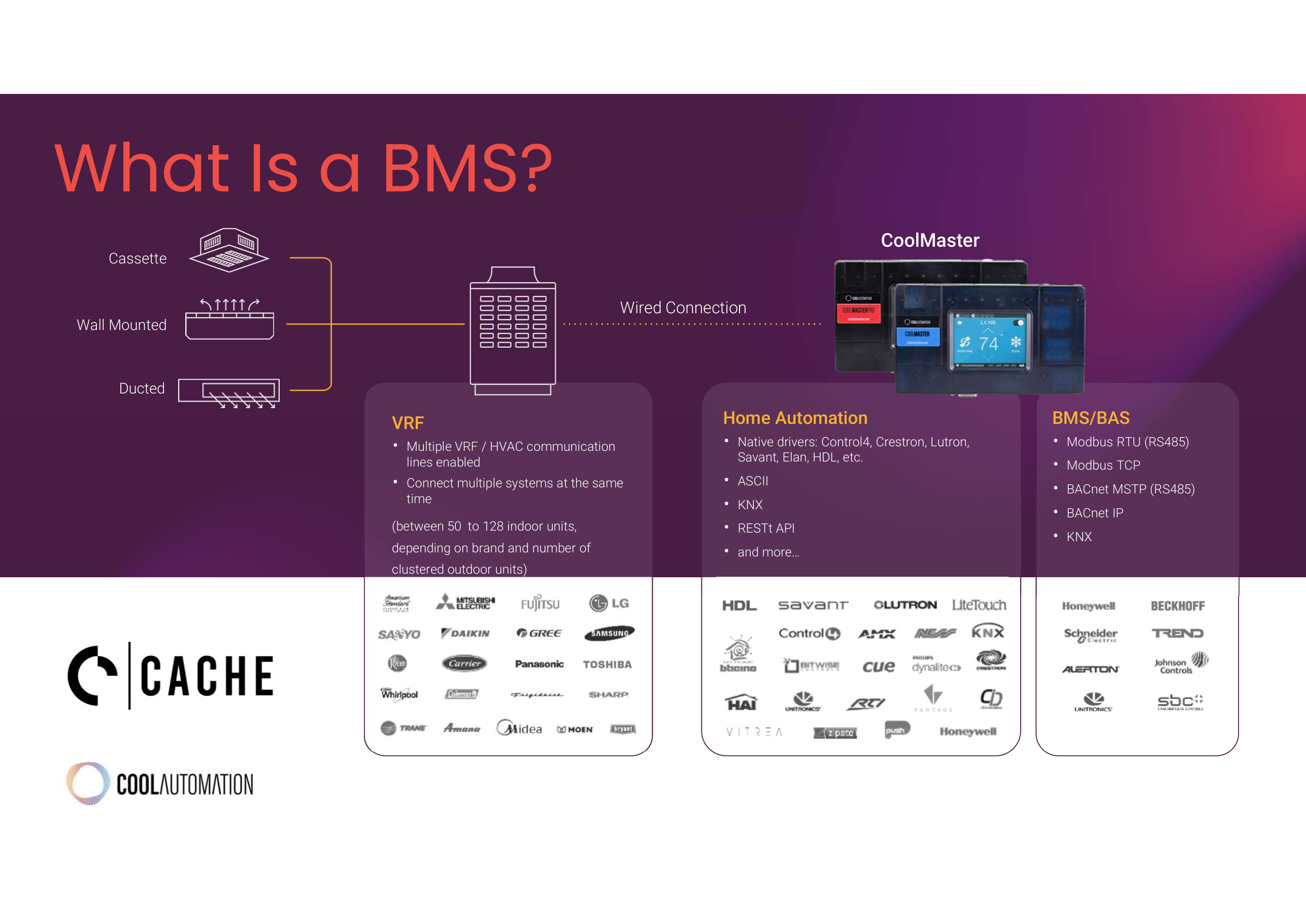
A building management system, or BMS, is a central platform that monitors and controls a building's core services, such as air conditioning, lighting, energy, access and security, from one place. Rather than each system running on its own, a BMS links them together so the building runs efficiently, comfortably and safely. In the UAE, where cooling drives energy use for most of the year, the single most important part of any BMS is how well it manages HVAC.
This guide explains what a BMS does, why it matters, what it controls, and why air conditioning sits at the heart of every building in Dubai and the wider GCC. It also covers the part that trips up most projects, getting the HVAC to talk to the BMS, and how CoolAutomation HVAC integration solves it.
At its core, a BMS gives a building two things: visibility and control. Visibility means seeing what every system is doing in real time, from indoor temperatures and energy use to whether a door is open or a plant room is running hot. Control means acting on that information automatically, setting schedules, adjusting temperatures by zone, dimming lighting, and responding to occupancy without anyone lifting a finger. The bigger and more complex the building, the more a BMS earns its place, because managing dozens of systems by hand is neither practical nor efficient.
A BMS matters for four reasons. It saves energy, because systems run only when and where they are needed rather than around the clock. It improves comfort, because temperature, air and lighting are held at the right levels automatically. It reduces maintenance costs, because faults are flagged early and staff can see problems remotely before they become failures. And it gives facilities teams control, because one platform manages the whole building instead of many separate apps and panels. For owners and operators, that combination means lower running costs and a building that simply works.
A typical BMS brings together several building services. HVAC, meaning heating, ventilation and air conditioning, is usually the largest. Lighting and shading manage daylight and energy. Energy and power monitoring track consumption across the building. Access control and security cover doors, cameras and alarms. Fire and life safety systems are monitored alongside them. In most buildings these systems come from different manufacturers, so the real job of a BMS is to pull them into one place where they can be seen and controlled together.
In the UAE, HVAC is not just one system among many, it is the one that matters most. Cooling runs for most of the year and accounts for the majority of a building's energy use, so how well the BMS manages air conditioning has the single biggest effect on running costs and comfort. Whether it is a villa with a VRF system, a hotel with hundreds of fan coil units, or a commercial tower on a chiller plant, the priority is the same: keep the building cool, keep occupants comfortable, and do it as efficiently as possible. A BMS that manages HVAC well is worth far more here than one that does not.
Here is the problem. Air conditioning systems from Daikin, Mitsubishi, LG, Samsung and others each speak their own language, and a BMS cannot control what it cannot understand. Historically this meant costly custom interfaces, or a BMS that could switch the AC on and off but not much more. To manage HVAC properly, the BMS needs full two way communication with every indoor unit: temperature, mode, fan speed, set points and fault status, across whatever brand of equipment is installed. Bridging that gap is exactly where CoolAutomation comes in.
CoolAutomation makes intelligent gateways that connect almost any brand of VRF, multi split or ducted air conditioning to a BMS or automation platform. Its CoolMaster gateways create a universal, two way channel between the air conditioning and the control system, using the protocols a BMS relies on such as BACnet and Modbus, as well as KNX, Crestron and Control4. A single CoolMaster can connect and control up to 30 indoor units, giving the BMS full visibility and control of temperature, mode, fan speed and faults for every unit. For retrofit projects, CoolPlug devices add integration at the indoor unit level, while the CoolLinkBridge brings centralised monitoring and cloud management across a whole property. The result is a BMS that manages HVAC in full, whatever the AC brand behind the wall. You can read more on how to get the most from HVAC systems with CoolMaster.
The right approach scales with the building. In a large villa, a BMS or smart home system with proper HVAC integration keeps each zone comfortable and efficient, and folds the AC into the wider smart home. In a hotel, central management of hundreds of rooms, with the ability to set back the AC in empty rooms, delivers major energy savings. In a commercial building, integrating chillers and fan coils into the BMS gives facilities teams the control and reporting they need to run the building well. In every case, HVAC integration is the foundation the rest of the BMS is built on.
Cache supplies CoolAutomation HVAC integration products to integrators and contractors across the UAE and GCC, with local stock and next day delivery. Whether you are specifying a single villa or a full development, you can explore the CoolAutomation range and talk to our team about connecting the air conditioning to your BMS or control platform. Contact us for product advice or a project quote.
What is a BMS?
A BMS, or building management system, is a central platform that monitors and controls a building's core services, such as air conditioning, lighting, energy, access and security, from one place.
What does a BMS control?
Typically HVAC, lighting and shading, energy and power monitoring, access control, security, and fire and life safety. In most buildings these come from different manufacturers, so the BMS brings them into one interface.
Why is HVAC so important in a UAE BMS?
Because cooling runs for most of the year and is the largest part of a building's energy use. How well the BMS manages air conditioning has the biggest effect on running costs and comfort.
How does a BMS connect to air conditioning?
Through an HVAC gateway. CoolAutomation CoolMaster gateways create a two way link between the air conditioning and the BMS using protocols such as BACnet and Modbus, so the BMS can monitor and control every indoor unit.
Where can I get BMS and HVAC integration products in the UAE?
Cache distributes CoolAutomation HVAC integration products to integrators across the UAE and GCC, with local stock and next day delivery. Contact our team for advice or a project quote.
We use cookies to ensure you get the best experience on our website.
